
Guides
How to prepare for a storm
The Met Office issues severe weather warnings up to seven days ahead, and storms likely to bring amber or red warnings are given a name, which gives you time to prepare. Two have been named so far in the 2026/27 season. This guide covers what to do before, during and after a storm, based on advice from the UK government's Be Ready campaign, the Met Office, Met Éireann and ESB Networks.
Updated:
CryMap is an emergency preparedness app for households that also works without a signal. Checklists for the most common emergencies are in CryMap too, offline and sized for your household. Get it for free
How storms are named
The Met Office, Met Éireann in Ireland and KNMI in the Netherlands name storms together. Any of the three can name a storm, taking the next name on the shared list. The Met Office names a storm when it could cause disruption or damage that might lead to an amber or red warning. Wind is the main factor, but rain and snow can also lead to a name. Met Éireann names storms when orange wind warnings are forecast for a wide area over land.
The 2026/27 list was published on 1 September 2026 and runs to the end of August 2027. It contains 21 names: Austen, Boelo, Chloe, Dano, Evelyn, Finn, Gwendolyn, Heather, Ivy, Jade, Kilian, Laoise, Miriam, Nicola, Olaf, Phelim, Ruban, Shaun, Theo, Vesna and Wende. According to the Met Office storm centre, Storm Austen was named on 20 October 2026 and Storm Boelo on 22 October 2026.
Names work. The Met Office reports that during Storm Goretti in January 2026, 93% of people in the amber warning area knew about the warning and 88% of them took action. What each warning colour means is explained in our weather warnings guide.
Before the storm: home and garden
Check the Met Office forecast or app, or Met Éireann in Ireland, and pay particular attention to severe weather warnings for your area. Be Ready suggests these steps once a storm is on the way.
- Secure or bring in ladders, trampolines, garden furniture, toys and anything else that could blow around
- Close and fasten doors and windows, especially those facing the wind, and large doors such as garage doors
- Keep loft hatches closed and bolted, especially if your roof pitch is less than 30 degrees
- Close and fasten any storm shutters
- Park in a garage if you have one, or away from buildings, trees, walls and fences
- If you sleep under a tall or poorly maintained chimney stack, move the bed away from the area directly below it
- Charge phones, power banks and backup batteries for any medical equipment
- Find out who your electricity network operator is and how to contact them
- Check whether schools or colleges will close and arrange childcare if needed
Travel: when not to drive
Be Ready advises limiting travel during a storm, allowing extra time and checking your operator's latest advice before you set off. Follow any Do Not Travel notices.
If you have to drive, avoid exposed routes such as bridges and high open roads, or delay the journey. Slow down and watch for side winds, especially if you are towing or driving a high-sided vehicle. The Met Office warning guide lists road and rail closures and travel delays among the typical impacts of an amber warning, and at red it advises avoiding travel where possible.
During the storm: where to stay
Stay indoors unless it is absolutely necessary to go out. If you must, do not shelter close to buildings, fences, boundary walls or trees, and use doors on the sheltered side of the house where you can. Open internal doors only when you need to and close them behind you.
Do not go outside to repair damage while the storm is still blowing. Wait until the wind has dropped.
Be Ready also notes that thunderstorms have been linked to worse asthma symptoms. If you have asthma, keep your inhalers within reach.
Fallen power lines and power cuts
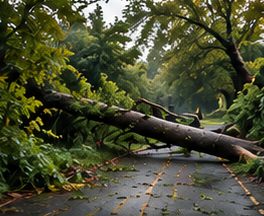
Keep as far away as possible from fallen or damaged power lines. Be Ready warns that high-voltage electricity can jump gaps without warning. After the storm, do not touch electricity or telephone cables that are down or still hanging.
In Ireland, ESB Networks says never to approach fallen wires or damaged poles and to report them straight away on 1800 372 999. Save the number in your phone before the storm. Its PowerCheck map shows outages and estimated restoration times.
A storm can bring down power lines across a wide area. What to keep ready, the 105 number and how to keep food cold are covered in our power cut guide. If phone lines and mobile masts are affected too, our guide to phone and internet outages explains how to reach 999.
After the storm
Damage is not always obvious. Be Ready advises against walking close to walls, buildings or trees, which may have been weakened, and against touching any cables that are down.
Check on neighbours and relatives who may need extra support and help them arrange repairs if they cannot do it themselves. Be Ready also suggests offering practical help to people in your community, such as getting food or medication.
If you use a generator during a power cut, ESB Networks warns never to plug it into a socket. It needs a proper changeover switch fitted by a registered electrical contractor.
Frequently asked questions
Who names storms in the UK and Ireland?
The Met Office, Met Éireann and the Dutch weather service KNMI name storms together from a shared list. The 2026/27 list starts with Austen, Boelo and Chloe.
When is a storm given a name?
The Met Office names a storm when it could cause disruption or damage that might lead to an amber or red warning. Met Éireann names storms when orange wind warnings are forecast over a wide area.
What should I do when an amber wind warning is issued?
Secure loose items, close and fasten doors and windows, charge phones and power banks, and consider changing travel plans. Be ready for power cuts.
Is it safe to drive in a storm?
Be Ready advises limiting travel and avoiding exposed routes such as bridges and high open roads. At a red warning the Met Office advises avoiding travel where possible.
What should I do if I see a fallen power line?
Keep well away and do not touch it, because high-voltage electricity can jump gaps. Report it to your network operator, or to ESB Networks on 1800 372 999 in Ireland.
Sources
- GOV.UK Be Ready – Storms
- Met Office – Official storm names for 2026/27 revealed
- Met Office – UK Storm Centre
- Met Éireann – Weather warnings
- ESB Networks – Be Winter Ready
- Met Office – Weather warnings guide
This page summarises the advice of the organisations named. In an emergency, follow the instructions of your local authorities.
Contains public sector information licensed under the Open Government Licence v3.0.